

As connected devices multiply across industries, organizations are generating massive volumes of real-time data from sensors, machines, vehicles, and smart infrastructure. Traditional cloud-centric analytics models struggle to keep up with latency requirements, bandwidth costs, and data privacy concerns.
Edge AI combined with IoT analytics solves this challenge by processing data closer to where it is generated. Instead of sending every data point to the cloud, intelligent models run directly on edge devices — enabling faster decisions, reduced costs, and improved operational resilience.
In this blog, we explore what Edge AI and IoT analytics are, how they work together, enterprise use cases, architectural considerations, and best practices for implementation.
What Is Edge AI?
Edge AI refers to deploying artificial intelligence models directly on edge devices such as IoT sensors, industrial machines, gateways, cameras, or embedded systems. These devices process and analyze data locally without relying entirely on centralized cloud infrastructure.
Traditional AI workflow:
Devices collect data → Send to cloud → Cloud processes → Results returned.
Edge AI workflow:
Devices collect data → AI processes locally → Immediate action taken → Select insights sent to cloud.
This shift dramatically reduces response time and bandwidth dependency while enabling autonomous decision-making.
What Is IoT Analytics?
IoT analytics involves collecting and analyzing data generated by Internet of Things devices to extract operational insights, detect anomalies, and optimize performance.
IoT analytics typically includes:
Sensor data processing
Stream analytics
Predictive modeling
Real-time monitoring
Historical trend analysis
When IoT analytics is combined with Edge AI, systems gain the ability to analyze and act instantly — rather than waiting for cloud-based processing.
Why Edge AI Matters in Modern Enterprises
Industries such as manufacturing, logistics, healthcare, energy, and smart cities operate in environments where milliseconds matter. Sending every sensor signal to the cloud can create latency bottlenecks and increase operational risk.
Edge AI delivers strategic advantages.
It reduces latency by enabling real-time decision-making.
It lowers cloud bandwidth and storage costs.
It improves reliability in low-connectivity environments.
It enhances data privacy by keeping sensitive information local.
It supports autonomous operations without constant cloud dependency.
For mission-critical systems, these capabilities are transformative.
How Edge AI & IoT Analytics Work Together
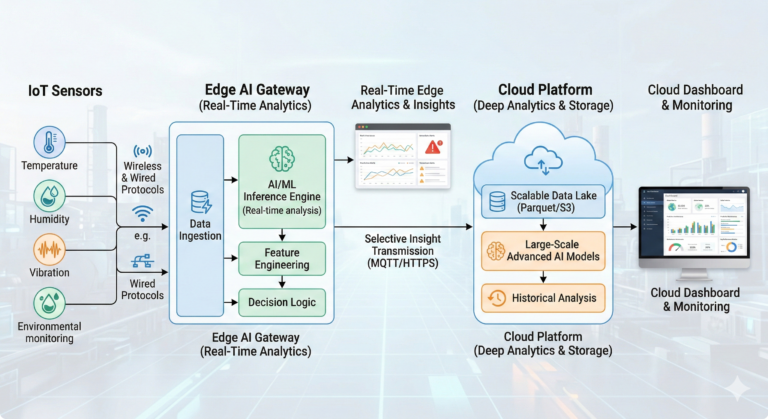
Edge AI and IoT analytics operate in a layered architecture.
IoT devices generate continuous streams of raw data. Edge processors or gateways run AI models to filter, analyze, and respond to this data locally. Only aggregated insights, anomalies, or relevant summaries are transmitted to the cloud for long-term storage and strategic analysis.
This hybrid approach balances immediate operational intelligence with centralized analytics for broader optimization.
For example, a manufacturing sensor may detect vibration anomalies in real time and trigger maintenance alerts instantly. Meanwhile, aggregated performance metrics are sent to the cloud to improve predictive maintenance models over time.
Key Enterprise Use Cases
Edge AI and IoT analytics are reshaping operational intelligence across industries.
1. Smart Manufacturing & Predictive Maintenance
Manufacturing facilities use IoT sensors to monitor equipment temperature, vibration, and pressure. Edge AI models detect early signs of equipment failure, enabling predictive maintenance before breakdowns occur. This reduces downtime, extends equipment lifespan, and lowers operational costs.
2. Smart Cities & Infrastructure
Cities deploy IoT-enabled cameras and sensors to manage traffic flow, monitor public safety, and optimize energy usage. Edge AI processes video streams locally to identify congestion or incidents instantly, minimizing response delays and reducing data transmission loads.
3. Retail & Customer Experience
Retailers use IoT sensors and computer vision systems to track inventory levels, analyze in-store customer behavior, and enable automated checkout experiences. Edge AI allows rapid decision-making without relying on constant cloud connectivity.
4. Healthcare Monitoring
Wearable devices and remote monitoring systems generate continuous patient data. Edge AI can analyze vital signs locally to detect abnormalities immediately, enabling faster intervention while safeguarding patient data privacy.
Architecture Considerations
Building Edge AI and IoT analytics solutions requires thoughtful architecture design.
Devices must support lightweight model deployment optimized for limited compute capacity. Communication protocols should enable secure and efficient data transfer. Cloud integration is essential for long-term analytics and centralized model updates. Model management pipelines must support remote updates and version control.
Security is critical. Edge devices can be vulnerable endpoints, so encryption, device authentication, and secure boot mechanisms are necessary.
A hybrid architecture — combining edge processing with centralized cloud intelligence — typically delivers the best balance of speed and scalability.
Challenges in Edge AI Deployment
Despite its advantages, Edge AI introduces complexity.
Edge devices often have limited compute and memory resources, requiring model optimization techniques such as quantization and pruning. Managing thousands of distributed devices requires strong orchestration and monitoring capabilities. Data consistency across distributed environments can be difficult to maintain.
Network constraints and intermittent connectivity must also be addressed to ensure reliable synchronization between edge and cloud systems.
Organizations must plan carefully to ensure scalability and maintainability.
Best Practices for Implementation
Successful Edge AI strategies start with identifying latency-sensitive, high-impact use cases. Begin with pilot deployments to validate performance under real-world conditions. Use lightweight, optimized models tailored to device capabilities. Implement centralized monitoring dashboards for visibility across distributed assets.
Security must be embedded from day one. Establish device lifecycle management processes, including remote updates and patching mechanisms. Align cloud and edge workflows to ensure continuous improvement through aggregated insights.
Edge AI should complement — not replace — cloud intelligence.
The Future of Edge AI & IoT Analytics
As 5G connectivity expands and edge hardware becomes more powerful, Edge AI adoption will accelerate. Industries will increasingly rely on autonomous systems capable of self-optimization without human intervention.
From smart grids and autonomous vehicles to intelligent supply chains and industrial robotics, the combination of Edge AI and IoT analytics will define next-generation operational intelligence.
The future of AI is not only in massive cloud data centers — it is also at the edge, embedded in the devices that power everyday operations.
Conclusion
Edge AI and IoT analytics enable organizations to process data where it is generated, unlocking real-time insights, reducing costs, and improving resilience. By balancing local intelligence with centralized analytics, enterprises can build adaptive systems capable of responding instantly to changing conditions.
As connected ecosystems continue to expand, businesses that invest in scalable Edge AI architectures will gain a competitive advantage in speed, efficiency, and innovation.
Explore our AI/ML services below
- Connect us – https://internetsoft.com/
- Call or Whatsapp us – +1 305-735-9875
ABOUT THE AUTHOR

Abhishek Bhosale
COO, Internet Soft
Abhishek is a dynamic Chief Operations Officer with a proven track record of optimizing business processes and driving operational excellence. With a passion for strategic planning and a keen eye for efficiency, Abhishek has successfully led teams to deliver exceptional results in AI, ML, core Banking and Blockchain projects. His expertise lies in streamlining operations and fostering innovation for sustainable growth