

As Artificial Intelligence adoption grows across industries, organizations are increasingly looking for efficient ways to build and deploy machine learning models. Traditionally, developing machine learning solutions required specialized expertise in data science, statistics, and model engineering. However, modern platforms now offer Automated Machine Learning (AutoML), which simplifies much of the development process.
AutoML tools automate many stages of the machine learning workflow, including data preprocessing, feature engineering, model selection, and hyperparameter tuning. On the other hand, custom machine learning development involves designing and training models manually using frameworks such as TensorFlow, PyTorch, or Scikit-learn.
Both approaches have advantages depending on the complexity of the problem, available expertise, and organizational goals. In this blog, we explore the differences between AutoML and custom ML, when to use each approach, and how organizations can choose the right strategy for their AI initiatives.
What Is AutoML?
Automated Machine Learning (AutoML) refers to tools and platforms that automate many steps of the machine learning pipeline. These systems enable users to build machine learning models with minimal manual intervention.
AutoML platforms typically perform tasks such as data preprocessing, feature engineering, algorithm selection, and hyperparameter optimization automatically. Users usually upload a dataset and specify the prediction objective, and the system generates and evaluates multiple models to identify the best-performing one.
This automation significantly reduces the technical barrier to entry for machine learning development. Business analysts, engineers, and domain experts can build predictive models without deep knowledge of algorithm design.
Many cloud platforms offer AutoML solutions that integrate with data pipelines and enterprise infrastructure, allowing organizations to deploy machine learning models quickly.
What Is Custom Machine Learning?
Custom machine learning refers to building models manually using programming frameworks and data science techniques. In this approach, data scientists and machine learning engineers design the entire workflow, from data preparation and feature engineering to model architecture and evaluation.
Custom ML allows teams to experiment with different algorithms, tune model parameters precisely, and design solutions tailored to specific business problems.This approach is commonly used when problems require specialized models, large-scale training systems, or complex data processing pipelines.
Although custom ML development requires more expertise and development time, it offers greater flexibility and control compared to automated tools.
Key Differences Between AutoML and Custom ML
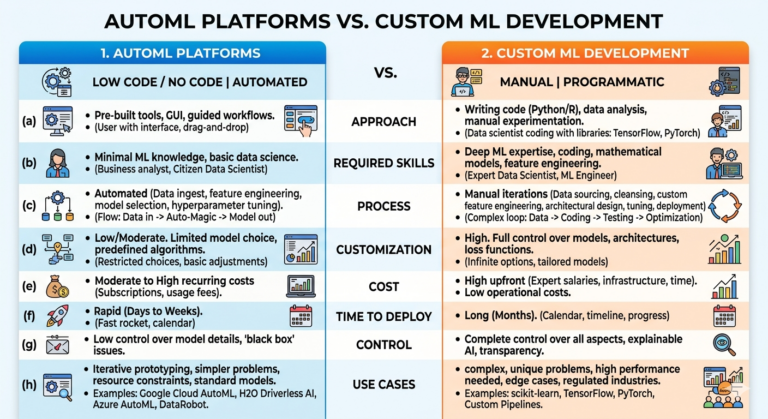
The main difference between AutoML and custom ML lies in the level of automation and control involved in the development process.
AutoML focuses on speed and accessibility. It automates repetitive tasks and simplifies model development, making machine learning more accessible to non-experts. However, this convenience sometimes comes at the cost of reduced customization and limited control over model design.
Custom machine learning, on the other hand, provides complete flexibility. Data scientists can design models tailored to specific use cases, incorporate domain knowledge into feature engineering, and experiment with advanced architectures.
Another key difference is scalability. While AutoML tools work well for many standard predictive tasks, custom ML solutions are often required for large-scale enterprise systems, deep learning applications, or highly specialized AI models.
Organizations must evaluate their requirements carefully to determine which approach aligns best with their needs.
Advantages of AutoML
AutoML provides several benefits for organizations beginning their machine learning journey or seeking rapid development.
One of the most significant advantages is speed of development. AutoML platforms can generate and evaluate multiple models automatically, reducing the time required to build predictive systems.
Another advantage is ease of use. Non-technical teams can experiment with machine learning models without needing deep expertise in algorithms or programming.
AutoML also improves productivity for data scientists by automating repetitive tasks such as hyperparameter tuning and model selection. This allows teams to focus more on strategic problem-solving and data analysis.
Additionally, AutoML platforms often integrate with cloud environments, making it easier to deploy and scale models within enterprise infrastructure.
Advantages of Custom Machine Learning
Custom machine learning offers several benefits when organizations need highly specialized or advanced AI systems.
One major advantage is greater flexibility. Data scientists can design models tailored to unique datasets, domain-specific challenges, and complex business requirements.
Custom ML also allows teams to implement advanced techniques such as deep learning architectures, reinforcement learning systems, or specialized natural language processing models.
Another important benefit is performance optimization. With full control over feature engineering, model design, and training processes, teams can optimize models for maximum accuracy and efficiency.
Custom ML also provides better transparency into how models work, which is particularly valuable in industries that require explainability and regulatory compliance.
When to Use AutoML?
AutoML is particularly effective in scenarios where organizations need to build predictive models quickly and efficiently.
It is often used for tasks such as customer churn prediction, sales forecasting, classification problems, and basic recommendation systems. These problems typically rely on structured datasets and well-understood algorithms.
AutoML is also useful for organizations that lack dedicated data science teams but still want to leverage machine learning for business insights.
Another common use case is rapid prototyping. Teams can quickly test multiple models and evaluate feasibility before investing in full-scale custom development.
In these scenarios, AutoML accelerates innovation while reducing technical complexity.
When to Use Custom Machine Learning?
Custom machine learning is better suited for complex problems that require specialized algorithms, large-scale data processing, or advanced AI capabilities.
Applications such as computer vision systems, natural language processing models, autonomous systems, and large recommendation engines often require custom model development.
Custom ML is also necessary when organizations must integrate machine learning deeply into their core products or operational systems.
Another scenario where custom ML is preferred is when performance optimization is critical. In high-stakes applications such as financial risk modeling or healthcare diagnostics, organizations often need complete control over model design and evaluation.
Custom ML enables teams to create highly optimized systems tailored to specific business goals.
Challenges of AutoML and Custom ML
Despite their advantages, both approaches present certain challenges.
- AutoML platforms may limit customization and transparency. Because many processes are automated, users may have less insight into how models are constructed and optimized.
- Custom machine learning, on the other hand, requires skilled data scientists, longer development cycles, and greater infrastructure investment.
- Another challenge for both approaches is managing the lifecycle of machine learning models after deployment. Monitoring, retraining, and maintaining models requires strong MLOps practices regardless of how the model was built.
Organizations should consider these factors when selecting their development strategy.
Conclusion
AutoML and custom machine learning represent two different approaches to building AI systems. AutoML focuses on automation, accessibility, and rapid development, enabling organizations to create machine learning models quickly with minimal technical expertise.
Custom machine learning provides greater flexibility, control, and performance optimization, making it ideal for complex AI applications and enterprise-scale systems. In many cases, organizations benefit from using both approaches together. AutoML can accelerate experimentation and prototyping, while custom ML enables the development of specialized models tailored to unique business challenges.
By choosing the right approach based on project requirements, organizations can maximize the value of their AI investments and build scalable, effective machine learning solutions.
Explore our AI/ML services below
- Connect us – https://internetsoft.com/
- Call or Whatsapp us – +1 305-735-9875
ABOUT THE AUTHOR

Abhishek Bhosale
COO, Internet Soft
Abhishek is a dynamic Chief Operations Officer with a proven track record of optimizing business processes and driving operational excellence. With a passion for strategic planning and a keen eye for efficiency, Abhishek has successfully led teams to deliver exceptional results in AI, ML, core Banking and Blockchain projects. His expertise lies in streamlining operations and fostering innovation for sustainable growth