

Businesses today operate in environments where demand, customer behavior, financial markets, and operational conditions constantly change. Predicting these patterns is essential for better planning and decision-making. Time-series forecasting with machine learning (ML) enables organizations to analyze historical data trends and generate accurate predictions about future outcomes.
From retail demand forecasting and energy consumption prediction to financial market analysis and supply chain planning, machine learning models help businesses transform historical data into actionable insights. Unlike traditional statistical models, ML-based forecasting systems can capture complex patterns, non-linear relationships, and hidden signals in time-dependent data.
In this blog, we explore how time-series forecasting works with machine learning, common techniques, implementation best practices, and where organizations can apply it effectively.
What Is Time-Series Forecasting?
Time-series forecasting is the process of predicting future values based on previously observed data points recorded over time. These data points are typically collected at consistent intervals such as hourly, daily, weekly, or monthly.
Examples of time-series data include:
- Daily sales of a retail store
- Website traffic over time
- Stock prices or financial indicators
- Energy consumption patterns
- Temperature or weather measurements
Machine learning models analyze historical patterns, trends, and seasonal behaviors in these datasets to forecast future outcomes.
Traditional statistical models such as ARIMA or exponential smoothing have been widely used for time-series forecasting. However, modern machine learning approaches can process larger datasets, incorporate external variables, and adapt more effectively to complex business environments.
Why Machine Learning Improves Time-Series Forecasting
Machine learning enhances forecasting by identifying deeper patterns that traditional models may overlook. Instead of relying purely on mathematical assumptions, ML models learn from data and improve predictions over time.
Machine learning-based forecasting offers several advantages:
Organizations can capture non-linear relationships in time-series data that traditional statistical models may struggle to represent. ML models also allow integration of multiple external variables, such as promotions, weather conditions, economic indicators, or customer behavior patterns.
Another major advantage is scalability. ML models can process large datasets from multiple sources simultaneously, enabling enterprise-scale forecasting systems. As new data becomes available, these models can be retrained to continuously improve prediction accuracy.
Key Components of Time-Series Forecasting with ML
A successful time-series forecasting system requires several core components working together. These components ensure that the model learns meaningful patterns from historical data and produces reliable predictions.

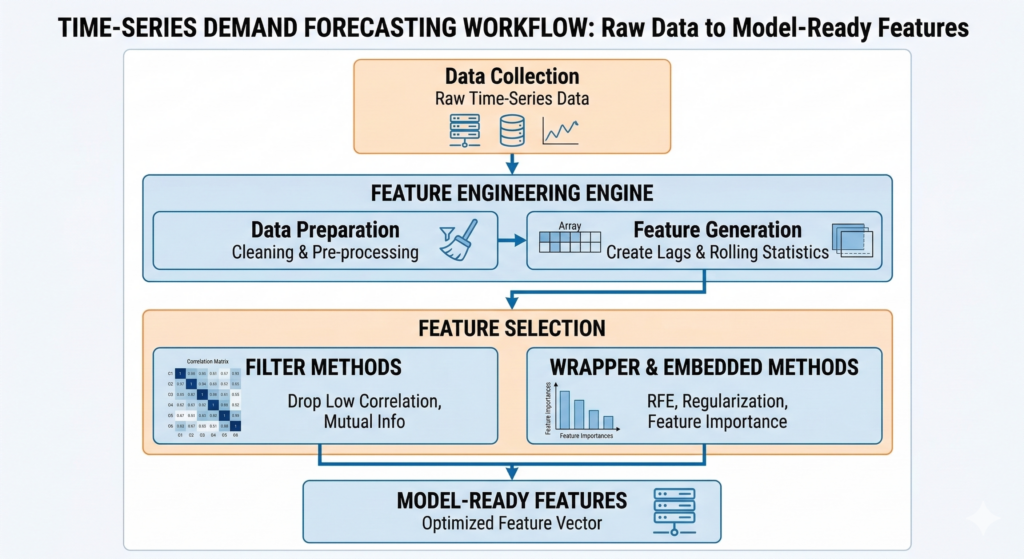
Data Collection and Preparation
Time-series forecasting begins with high-quality historical data. This data must be organized chronologically and cleaned before training models.
Data preparation typically includes handling missing values, correcting anomalies, and ensuring consistent time intervals. In many business scenarios, datasets may also require merging data from multiple systems such as ERP platforms, CRM databases, or IoT devices.
Feature engineering also plays a crucial role in this stage. Time-related features such as day-of-week, month, holidays, or seasonal patterns are often added to help models recognize recurring trends.
Feature Engineering for Time-Series Data
Feature engineering transforms raw time-series data into structured inputs that machine learning models can understand.
Common features include lag variables, rolling averages, and trend indicators derived from historical data points. These features help the model capture temporal relationships within the dataset.
For example, a retail demand forecasting model may include features such as sales from the previous day, sales from the previous week, promotional events, and seasonal effects. Combining these features enables models to understand both short-term fluctuations and long-term trends.
Proper feature engineering significantly improves the predictive power of machine learning models.
Model Selection
Different machine learning models can be used for time-series forecasting depending on the complexity of the data and the forecasting horizon.
Tree-based algorithms such as Random Forest and Gradient Boosting are commonly used because they handle complex patterns and non-linear relationships well. These models also perform effectively when combined with engineered features.
Deep learning models are increasingly used for advanced forecasting tasks. Recurrent neural networks (RNNs) and long short-term memory (LSTM) networks are designed specifically to process sequential data and capture long-term dependencies within time-series datasets.
In many enterprise systems, organizations experiment with multiple models and choose the best-performing one based on validation results.
Model Training and Validation
Once the dataset and features are prepared, the model must be trained using historical data. Training involves teaching the model to recognize patterns that connect past data points to future outcomes.
Unlike traditional machine learning tasks, time-series validation must respect chronological order. Randomly shuffling data can lead to inaccurate evaluations. Instead, techniques such as time-based cross-validation or rolling window validation are used to simulate real-world forecasting scenarios.
Model performance is usually evaluated using metrics such as mean absolute error (MAE), root mean squared error (RMSE), or mean absolute percentage error (MAPE).
Deployment and Continuous Monitoring
After validation, forecasting models are deployed into production systems where they generate predictions automatically.
In real-world environments, forecasting models must be continuously monitored because data patterns change over time. Market shifts, seasonality changes, or new business strategies can impact model accuracy.
Monitoring systems track performance metrics and trigger retraining pipelines when prediction accuracy begins to decline. This continuous improvement process ensures that forecasting models remain reliable as business conditions evolve.
Common Business Applications of Time-Series Forecasting
Time-series forecasting is widely used across industries to improve planning, reduce risk, and optimize operations.
In retail and eCommerce, forecasting models help predict product demand, optimize inventory levels, and plan promotions more effectively. In financial services, forecasting is used to predict stock movements, credit risk trends, and market volatility.
Energy companies rely on time-series forecasting to predict electricity demand and optimize power generation. Logistics organizations use it to forecast shipping volumes and optimize delivery schedules.
Healthcare systems also use forecasting models to predict patient admissions, manage hospital resources, and plan staffing requirements.
Across industries, time-series forecasting supports proactive decision-making instead of reactive responses.
Best Practices for Implementing Time-Series Forecasting
Organizations adopting machine learning for forecasting should follow several best practices to ensure reliable outcomes.
Start by ensuring high-quality, well-structured data. Inconsistent or incomplete datasets can significantly impact prediction accuracy. Investing in robust data pipelines and data governance improves model performance.
Next, focus on feature engineering. Time-based features, lag variables, and external signals can dramatically enhance forecasting accuracy.
Organizations should also experiment with multiple models instead of relying on a single approach. Comparing results from statistical models, machine learning models, and deep learning models often leads to better performance.
Finally, monitoring and retraining systems must be implemented to adapt to changing data patterns. Forecasting models should evolve continuously as new data becomes available.
Challenges in Time-Series Forecasting
Despite its benefits, time-series forecasting presents several challenges that organizations must address.
One common challenge is data seasonality and volatility, which can make patterns difficult to predict accurately. Unexpected events such as economic changes, supply disruptions, or global crises can also impact forecasts.
Another challenge is data sparsity or missing values, especially in new business lines or emerging markets where historical data is limited.
Finally, scaling forecasting systems across large enterprises requires robust infrastructure, automated pipelines, and MLOps practices to manage model lifecycle and performance monitoring.
Addressing these challenges requires strong data engineering, domain expertise, and continuous experimentation.
Conclusion
Time-series forecasting with machine learning enables organizations to transform historical data into strategic foresight. By identifying patterns, trends, and seasonality in time-dependent datasets, businesses can predict demand, optimize operations, and make better data-driven decisions.
Successful forecasting systems combine high-quality data pipelines, effective feature engineering, robust machine learning models, and continuous monitoring. When implemented correctly, ML-powered forecasting helps organizations move from reactive decision-making to proactive planning.
As businesses generate increasing volumes of time-based data, machine learning-driven forecasting will become an essential capability for improving efficiency, reducing uncertainty, and maintaining a competitive advantage.
Explore our AI/ML services below
- Connect us – https://internetsoft.com/
- Call or Whatsapp us – +1 305-735-9875
ABOUT THE AUTHOR

Abhishek Bhosale
COO, Internet Soft
Abhishek is a dynamic Chief Operations Officer with a proven track record of optimizing business processes and driving operational excellence. With a passion for strategic planning and a keen eye for efficiency, Abhishek has successfully led teams to deliver exceptional results in AI, ML, core Banking and Blockchain projects. His expertise lies in streamlining operations and fostering innovation for sustainable growth