


As organizations increasingly rely on AI to drive business decisions, data privacy and regulatory compliance have become central concerns. Industries such as healthcare, finance, telecommunications, and public services handle highly sensitive data that cannot be freely shared across systems or geographic boundaries.
Federated Learning addresses this challenge by enabling collaborative model training without moving raw data. Instead of centralizing datasets, federated learning allows models to learn directly from decentralized data sources — preserving privacy while still benefiting from collective intelligence.
This blog explores what federated learning is, how it works, key benefits, enterprise use cases, and best practices for implementation.

What Is Federated Learning?
Federated Learning is a distributed machine learning approach where multiple devices or organizations train a shared model collaboratively without exchanging raw data.
Traditional machine learning follows a centralized approach:
Data is collected in one location → Model is trained → Model is deployed.
Federated learning reverses this logic:
Model is sent to data sources → Local training occurs → Only model updates are shared → Global model is aggregated.
This architecture minimizes data movement and significantly reduces privacy risks.
How Federated Learning Works
At a high level, federated learning follows a structured cycle.
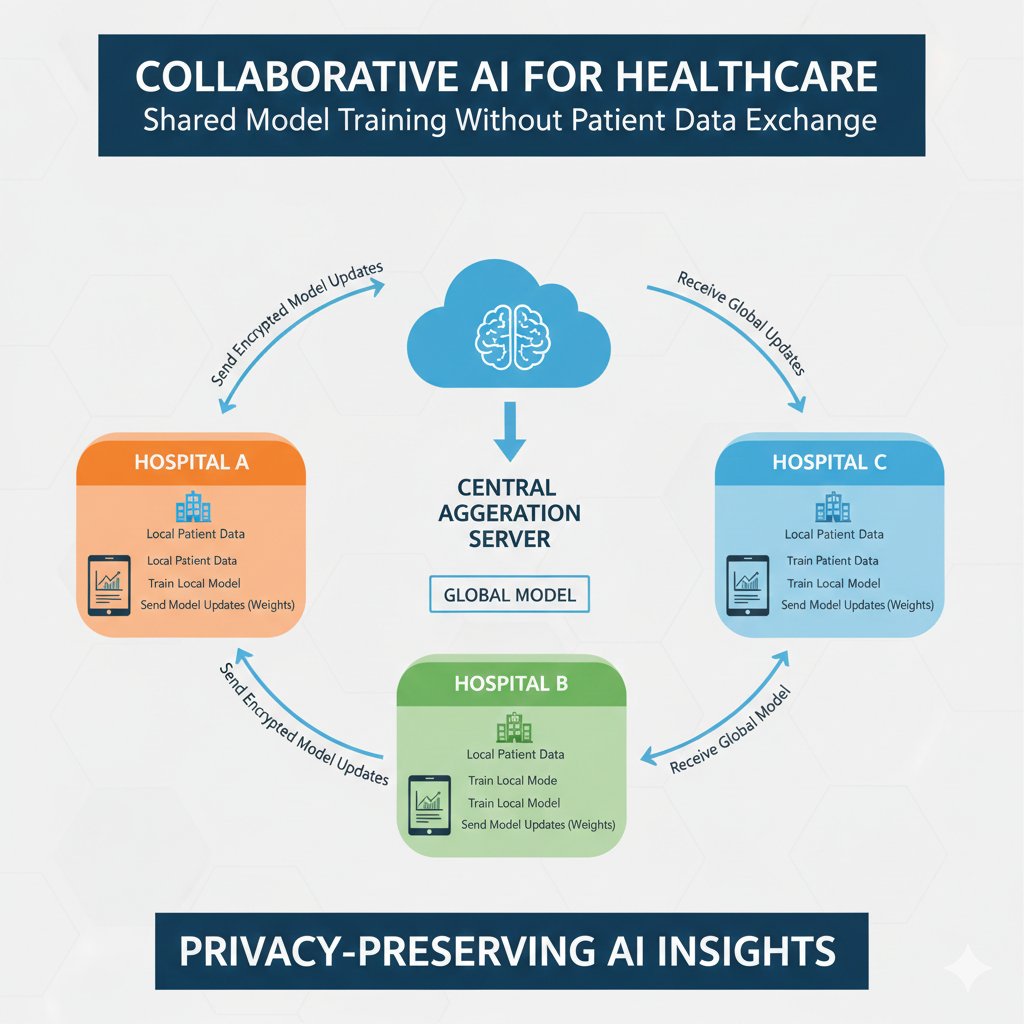
First, a global model is initialized on a central server. This model is distributed to participating nodes — which could be mobile devices, hospitals, banks, or regional offices.
Each node trains the model locally using its own data. Instead of sending raw data back, it sends model updates (such as gradients or weight changes) to the central server.
The server aggregates these updates, typically using algorithms like Federated Averaging, to produce an improved global model. The updated model is redistributed, and the process repeats across multiple training rounds.
Over time, the model learns from diverse data sources without ever exposing sensitive data externally.
Why Federated Learning Matters
Data privacy regulations such as GDPR and HIPAA restrict how organizations can store and transfer personal data. Centralized AI architectures can create compliance risks, security vulnerabilities, and operational bottlenecks.
Federated learning offers several strategic advantages.
It enhances privacy by keeping data local.
It reduces regulatory exposure by minimizing cross-border data transfer.
It lowers central storage requirements.
It enables collaboration across organizations that cannot legally share raw datasets.
For enterprises operating in regulated environments, federated learning creates a viable path to scalable AI adoption without compromising governance standards.
Enterprise Use Cases
Federated learning is particularly valuable in industries where data sensitivity and distribution are significant challenges.
In healthcare, hospitals can collaboratively train diagnostic models without sharing patient records. This approach improves model accuracy by learning from diverse populations while preserving confidentiality.
In financial services, banks can train fraud detection systems collectively without exposing customer transaction histories.
In telecommunications, distributed edge devices can improve predictive maintenance models while keeping operational data localized.
In mobile applications, on-device federated learning allows personalization models to improve continuously without uploading user behavior data to central servers.
These use cases demonstrate how federated learning enables cooperation without sacrificing privacy.
Technical Components of Federated Learning
Implementing federated learning requires specialized infrastructure.
A central orchestration server coordinates training rounds and aggregates updates. Secure communication channels ensure encrypted transmission of model parameters. Differential privacy techniques can be applied to further mask sensitive information within updates. Secure aggregation protocols prevent individual updates from being reverse-engineered.
Additionally, federated learning systems must handle heterogeneous data distributions, device variability, and intermittent connectivity.
This makes engineering complexity higher than traditional centralized ML systems.
Challenges and Limitations
While federated learning offers strong privacy benefits, it is not without challenges.
Data across nodes may be non-identically distributed, which can reduce model convergence stability. Devices may have inconsistent compute capacity, creating uneven training contributions. Communication overhead can become significant when coordinating many participants.
There are also potential privacy risks if model updates are not properly secured. Techniques such as differential privacy and homomorphic encryption are often integrated to mitigate these concerns.
Organizations must carefully evaluate trade-offs between privacy gains and system complexity.
Best Practices for Enterprise Adoption
Successful federated learning initiatives require both technical and governance readiness.
Start by identifying high-value use cases where data cannot be centralized due to regulatory or competitive constraints. Ensure strong encryption and secure aggregation protocols are in place. Implement monitoring to track model performance across nodes. Establish clear participation policies and compliance documentation.
It is also critical to evaluate whether federated learning is necessary. In some scenarios, anonymization or secure centralized storage may be sufficient. Federated learning is most valuable when legal, operational, or trust constraints prevent raw data sharing.
Federated Learning vs Centralized Learning
Centralized learning offers simpler architecture and easier optimization but increases privacy and security risks.
Federated learning provides stronger data protection and collaborative intelligence but requires more sophisticated orchestration, monitoring, and governance.
The decision depends on regulatory environment, data sensitivity, infrastructure maturity, and long-term strategic goals.
The Future of Federated Learning
As edge computing expands and privacy regulations tighten globally, federated learning is expected to become more mainstream. Advances in secure multiparty computation, encrypted aggregation, and efficient communication protocols are reducing implementation complexity.
In the coming years, federated learning will likely integrate with edge AI, IoT ecosystems, and enterprise collaboration networks, enabling secure AI systems that scale across distributed environments.
Conclusion
Federated learning represents a powerful shift in how AI systems are trained. By moving models to data instead of moving data to models, organizations can collaborate, innovate, and improve predictive accuracy without compromising privacy.
For enterprises operating in highly regulated industries, federated learning offers a strategic pathway to scalable, compliant AI. While it introduces architectural complexity, its privacy-preserving capabilities make it an essential consideration for modern AI infrastructure.
Explore our AI/ML services below
- Connect us – https://internetsoft.com/
- Call or Whatsapp us – +1 305-735-9875
ABOUT THE AUTHOR

Abhishek Bhosale
COO, Internet Soft
Abhishek is a dynamic Chief Operations Officer with a proven track record of optimizing business processes and driving operational excellence. With a passion for strategic planning and a keen eye for efficiency, Abhishek has successfully led teams to deliver exceptional results in AI, ML, core Banking and Blockchain projects. His expertise lies in streamlining operations and fostering innovation for sustainable growth