

Artificial Intelligence has evolved rapidly over the past decade. From text-based chatbots to advanced generative models, AI systems are becoming increasingly capable of understanding and producing human-like outputs. But the next big leap in AI is not just about better language understanding—it’s about multimodal intelligence.
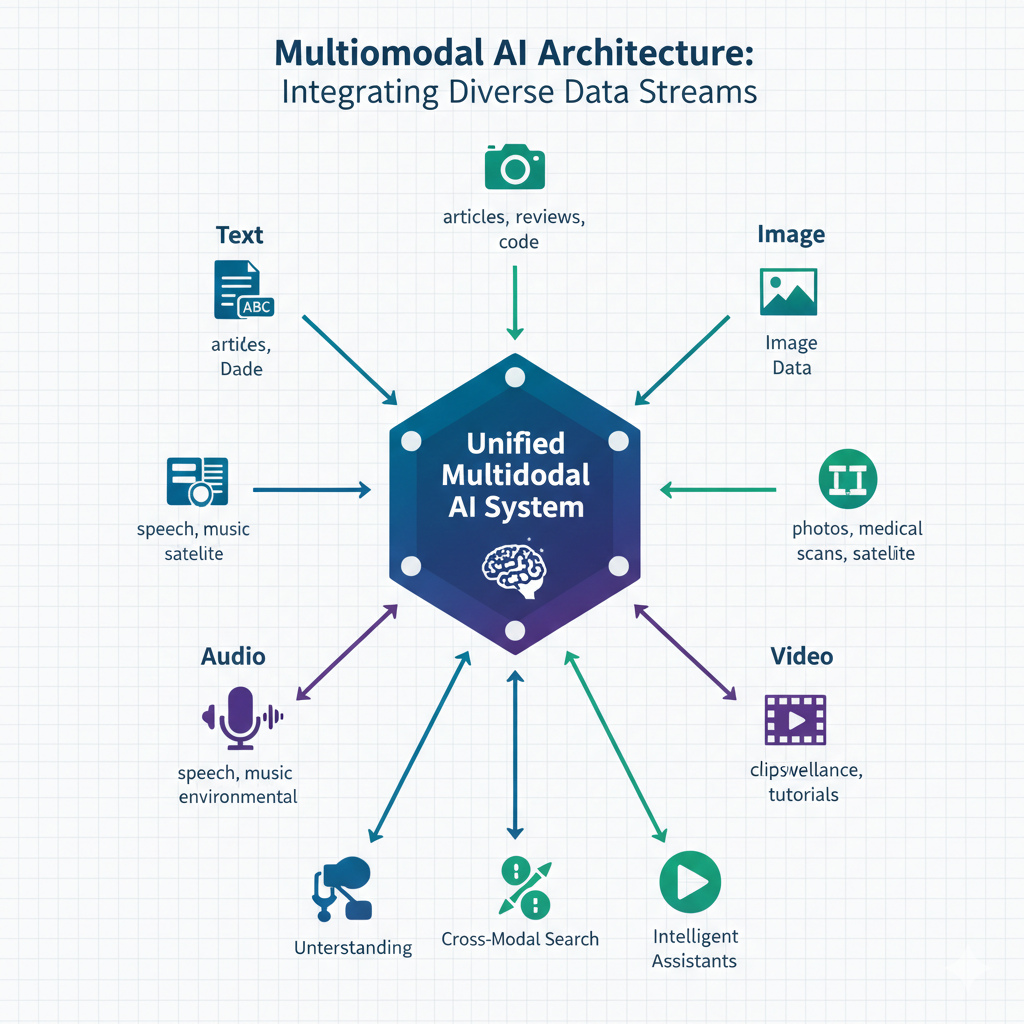
Multimodal AI systems are designed to process and integrate multiple types of data simultaneously, such as text, images, audio, video, and even sensor inputs. Instead of operating within a single data modality, these systems mirror how humans naturally perceive and interpret the world—through a combination of sight, sound, language, and context.
What Are Multimodal AI Systems?
A multimodal AI system can analyze different types of inputs together and generate context-aware outputs. For example:
- Understanding an image and answering questions about it
- Generating a caption for a video clip
- Converting speech into text while interpreting emotional tone
- Creating images based on written prompts
Unlike unimodal models (which handle only text or only images), multimodal systems combine diverse data streams into a shared representation space. This allows them to form deeper contextual understanding and produce richer, more accurate outputs.
Why Multimodal AI Matters?
Humans do not interpret information in isolation. When we watch a movie, we simultaneously process dialogue (text/audio), facial expressions (visual), background music (audio), and context (memory). Multimodal AI attempts to replicate this integrated perception.
The impact is significant:
- Better context understanding – Combining image + text reduces ambiguity.
- Improved decision-making – Video + sensor data enhances real-time analytics.
- Natural user interaction – Voice, gestures, and visuals create seamless experiences.
- Higher accuracy in complex tasks – Especially in healthcare, manufacturing, and autonomous systems.
This integrated approach is pushing AI from being “smart tools” toward becoming adaptive digital collaborators.
Core Components of Multimodal Systems
Building a multimodal AI system involves several technical components:
1. Modality-Specific Encoders
Each input type (text, image, audio) is processed by a specialized encoder.
- Text → Language models
- Images → Vision transformers or CNNs
- Audio → Speech recognition models
2. Cross-Modal Fusion
The system combines encoded representations into a shared embedding space. This is where alignment happens—linking a word to an object in an image, or tone to sentiment.
3. Attention Mechanisms
Cross-modal attention allows the system to focus on relevant parts of each modality. For example, aligning spoken words with visual cues in a video.
4. Output Generators
Based on combined understanding, the model generates text, speech, images, or predictions.
Real-World Applications
Multimodal AI is already transforming industries:
1.Healthcare
AI can analyze medical images alongside patient records and doctor notes, improving diagnostic accuracy and clinical decision-making.
2.Autonomous Vehicles
Self-driving systems combine camera feeds, radar, LiDAR, and GPS data to understand their environment in real time.
3.E-Commerce
Shoppers can upload an image of a product and receive recommendations, descriptions, and price comparisons instantly.
4.Smart Assistants
Voice assistants can now interpret visual context (like objects in front of a camera) along with spoken instructions.
5.Content Creation
AI can generate video subtitles, create images from text prompts, and even synthesize audio narration.
Challenges in Multimodal AI
Despite its promise, multimodal AI introduces new complexities:
- Data alignment issues – Ensuring text matches the correct image or audio sample.
- Computational cost – Training multimodal models requires large-scale datasets and processing power.
- Bias amplification – Bias across multiple modalities can compound.
- Integration complexity – Fusion strategies must be carefully designed to avoid performance degradation.
These challenges require careful architecture design, robust training pipelines, and responsible AI governance.
The Future of Multimodal Intelligence
The next generation of AI systems will not operate in silos. Instead, they will seamlessly integrate text, visuals, audio, and structured data to deliver deeper insights and more natural human interaction.
We are moving toward AI systems that can:
- Watch, listen, read, and respond
- Collaborate across digital and physical environments
- Provide contextual, emotionally aware interactions
Multimodal AI is not just an incremental improvement—it represents a fundamental shift toward more human-like intelligence.
As businesses continue adopting AI-driven automation, multimodal systems will become central to enterprise transformation, customer engagement, and intelligent decision-making.
Final Thoughts
Multimodal AI systems are redefining what artificial intelligence can achieve. By bridging the gap between different forms of data, they enable richer understanding, smarter automation, and more intuitive human-machine collaboration.
The organizations that invest early in multimodal capabilities will gain a significant competitive advantage in the evolving AI landscape.
Explore our AI/ML services below
- Connect us – https://internetsoft.com/
- Call or Whatsapp us – +1 305-735-9875
ABOUT THE AUTHOR

Abhishek Bhosale
COO, Internet Soft
Abhishek is a dynamic Chief Operations Officer with a proven track record of optimizing business processes and driving operational excellence. With a passion for strategic planning and a keen eye for efficiency, Abhishek has successfully led teams to deliver exceptional results in AI, ML, core Banking and Blockchain projects. His expertise lies in streamlining operations and fostering innovation for sustainable growth