

Artificial Intelligence in business has evolved from descriptive analytics to predictive modeling—and now to autonomous decision-making. At the forefront of this shift is Reinforcement Learning (RL), a powerful AI paradigm that enables systems to learn optimal strategies through trial and error.
Unlike traditional machine learning models that rely heavily on labeled datasets, reinforcement learning agents improve by interacting with environments, receiving feedback in the form of rewards or penalties, and continuously refining their actions. In a business context, this means AI systems can dynamically adapt strategies to maximize outcomes such as revenue, efficiency, customer satisfaction, or risk reduction.
What is Reinforcement Learning?
Reinforcement Learning is based on a simple but powerful concept:
- Agent – The decision-maker (AI system)
- Environment – The business system or operational setting
- Action – A decision taken by the agent
- Reward – Feedback signal based on the outcome
The goal of the agent is to learn a policy—a strategy that maximizes long-term rewards. Over time, the system becomes better at selecting actions that drive optimal business results.
Why Reinforcement Learning Matters in Business?
Traditional analytics answers:
- What happened?
- Why did it happen?
- What might happen next?
- What should we do right now to maximize long-term value?
Reinforcement learning answers:
This shift is transformational. RL enables systems to move beyond static decision rules and become adaptive, data-driven decision engines.
Key advantages include:
- Dynamic optimization in real-time
- Continuous improvement without manual reprogramming
- Better handling of complex, changing environments
- Long-term value maximization rather than short-term gains
Real-World Business Applications
1. Dynamic Pricing & Revenue Optimization
E-commerce platforms and airlines use RL to adjust prices based on demand, competitor activity, and customer behavior. Instead of static pricing rules, reinforcement learning systems continuously experiment and optimize for revenue and conversion rates.
2. Supply Chain & Inventory Management
RL helps businesses optimize inventory levels, routing decisions, and warehouse operations. By balancing storage costs, demand variability, and delivery timelines, companies reduce waste while maintaining service quality.
3. Marketing Campaign Optimization
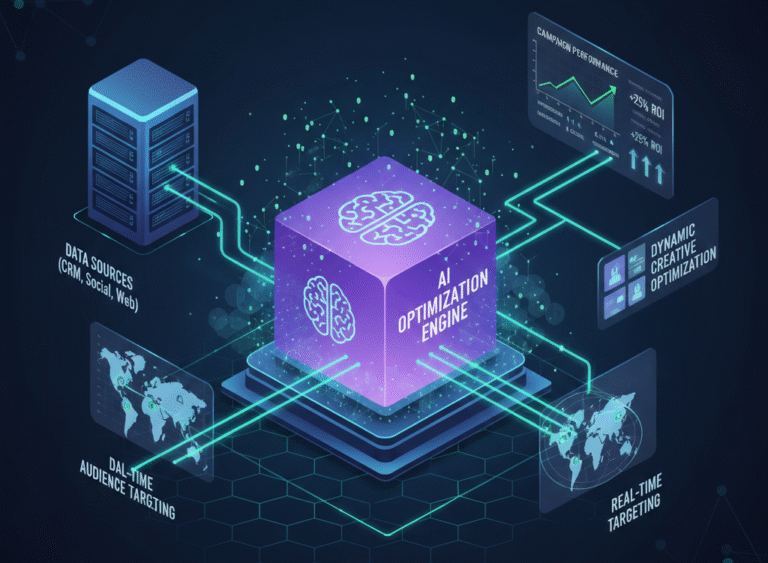
Reinforcement learning can automatically allocate marketing budgets across channels, personalize offers, and adjust campaign strategies based on engagement metrics. Instead of fixed A/B tests, RL enables continuous experimentation and improvement.
4. Fraud Detection & Risk Management
In financial services, RL models learn patterns of normal and suspicious behavior. They dynamically adjust risk thresholds and detection strategies to minimize false positives while catching real threats.
5. Autonomous Operations & Robotics
In manufacturing and logistics, RL powers autonomous robots that optimize movement, scheduling, and task execution—reducing downtime and increasing productivity.
Key Challenges in Business Adoption
Despite its promise, reinforcement learning presents several challenges:
- Data & environment simulation requirements – RL often needs simulated environments before deployment.
- Exploration risk – Trial-and-error learning can be costly in real-world settings.
- High computational costs – Training complex RL models demands significant resources.
- Explainability concerns – Business leaders require transparency in decision logic.
Organizations must balance innovation with risk management and governance frameworks.
The Future of Reinforcement Learning in Enterprise
Reinforcement learning is rapidly evolving alongside advances in deep learning and large-scale computing. When integrated with predictive analytics, generative AI, and real-time data pipelines, RL can become the decision-making core of digital enterprises.
We are moving toward systems that:
- Continuously optimize pricing, logistics, and resource allocation
- Adapt instantly to market volatility
- Learn from customer interactions in real time
- Automate strategic decision layers, not just operational tasks
As businesses seek competitive advantage through intelligent automation, reinforcement learning will play a critical role in building self-optimizing organizations.
Final Thoughts
Reinforcement Learning represents a fundamental shift from predictive AI to autonomous AI. It empowers businesses to build systems that not only analyze data—but act on it intelligently and continuously.
For enterprises ready to embrace adaptive, real-time optimization, reinforcement learning is no longer experimental—it’s strategic.
Explore our AI/ML services below
- Connect us – https://internetsoft.com/
- Call or Whatsapp us – +1 305-735-9875
ABOUT THE AUTHOR

Abhishek Bhosale
COO, Internet Soft
Abhishek is a dynamic Chief Operations Officer with a proven track record of optimizing business processes and driving operational excellence. With a passion for strategic planning and a keen eye for efficiency, Abhishek has successfully led teams to deliver exceptional results in AI, ML, core Banking and Blockchain projects. His expertise lies in streamlining operations and fostering innovation for sustainable growth