
Enterprise AI has moved far beyond experimentation. Organizations are no longer testing isolated pilots—they are embedding AI into core business processes, from decision intelligence and automation to customer experience and risk management. As AI technologies mature, the focus is shifting toward enterprise-wide ecosystems that are scalable, governed, and aligned with measurable business outcomes.
The future of enterprise AI will be shaped by responsible adoption, deep integration with existing systems, and a clear return on investment. Intelligent businesses will not simply deploy AI—they will operationalize it strategically.
Why Enterprise AI Is Entering a New Era?
Early AI initiatives centered on proofs of concept and departmental experimentation. Today, enterprises demand production-grade AI systems that are scalable across business units, secure and compliant, cost-efficient, explainable, and seamlessly integrated into existing enterprise platforms.
AI is no longer a “nice-to-have” innovation layer. It is becoming a core enterprise capability that influences strategy, operations, and competitive positioning. The conversation has shifted from “Can we build it?” to “How do we scale it responsibly?”
1. AI Moving from Automation to Decision Intelligence
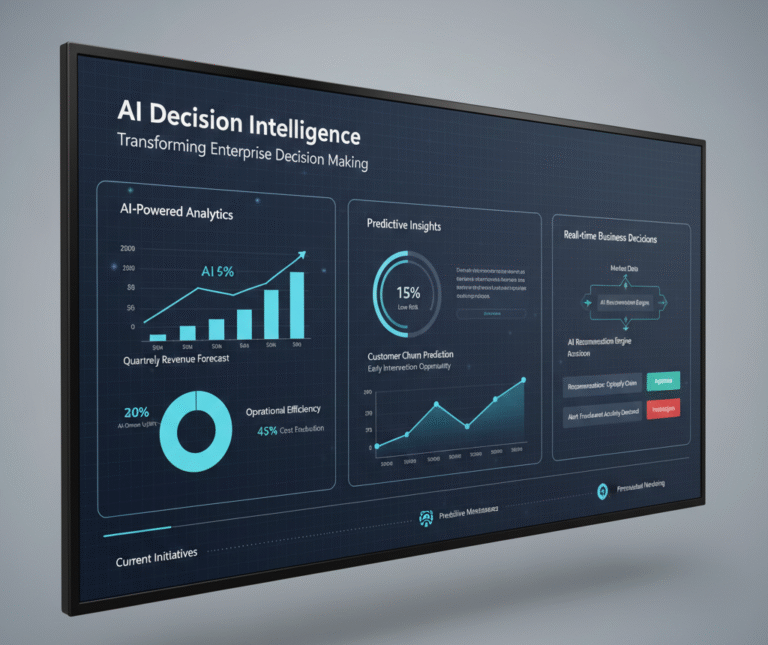
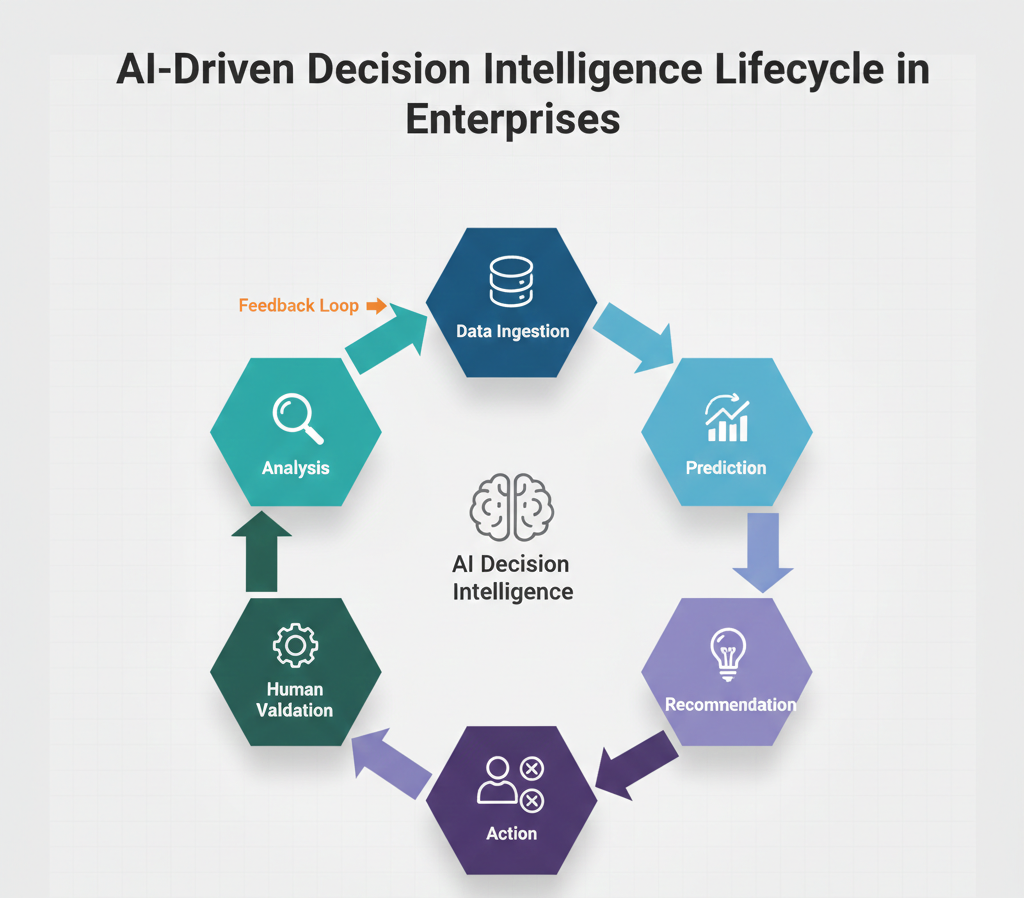
The next phase of enterprise AI focuses on augmenting human judgment rather than simply automating repetitive tasks. Decision intelligence systems combine predictive analytics, real-time data processing, and scenario modeling to guide complex business decisions.
Enterprises are increasingly using AI for executive-level insights, prescriptive analytics, forecasting, and operational optimization. Instead of merely executing predefined rules, AI systems are evolving into strategic advisors that enhance planning, risk management, and performance management across departments.
2. Rise of AI Copilots Across Enterprise Functions
AI copilots are becoming embedded across enterprise functions—not just within IT teams. These systems act as intelligent assistants that enhance productivity while keeping humans in control.
In software development and IT operations, copilots accelerate coding and troubleshooting. In sales and marketing, they personalize campaigns and analyze customer intent. Finance, legal, compliance, and HR teams are leveraging AI to streamline documentation, risk reviews, and talent analytics.
The future enterprise workforce will increasingly collaborate with AI copilots as part of everyday workflows, improving efficiency without replacing human oversight.
3. Generative AI Becoming Enterprise-Grade
Generative AI is transitioning from experimentation to production-ready deployment. While early adoption focused on creativity and content generation, enterprise-grade generative AI emphasizes governance, privacy, and reliability.
Future systems will prioritize data protection, intellectual property safeguards, explainability, and secure integration with internal enterprise data sources. Outputs will be controlled, auditable, and aligned with compliance standards. This maturation will make generative AI a trusted enterprise tool rather than a high-risk innovation experiment.
4. Responsible, Explainable, and Compliant AI
As AI adoption scales, governance becomes a strategic priority. Enterprises must ensure transparency in how models make decisions, particularly in regulated industries.
Future AI strategies will emphasize explainable AI (XAI), bias detection and mitigation, and compliance with regulations such as HIPAA, GDPR, and SOC 2. Transparent decision-making frameworks will not only satisfy regulatory requirements but also strengthen stakeholder trust.
Responsible AI will increasingly serve as a competitive differentiator. Organizations that demonstrate fairness, accountability, and transparency will gain long-term credibility in AI-driven markets.
5. AI Integrated Deeply into Enterprise Systems
AI will no longer operate in isolated applications. Instead, it will be embedded directly into enterprise systems such as ERP and CRM platforms, supply chain management tools, financial systems, and customer experience applications.
This deep integration enables end-to-end intelligence across workflows. Rather than analyzing data in isolation, AI will continuously inform and optimize interconnected business processes. The result is a more responsive, adaptive enterprise capable of making real-time, data-driven decisions.
6. Cost-Aware and Scalable AI Architectures
The future of enterprise AI is not only powerful—it is economically optimized. Organizations are increasingly adopting hybrid and multi-cloud strategies to balance performance and cost. Model optimization techniques and right-sizing practices help reduce inference expenses while maintaining performance.
Cost-aware MLOps frameworks and ROI measurement models are becoming standard components of enterprise AI strategy. Businesses are treating AI spending as a strategic investment, ensuring measurable outcomes rather than uncontrolled experimentation.
Conclusion
Enterprise AI is entering a new phase defined by scalability, governance, and strategic integration. The future belongs to organizations that move beyond isolated use cases and build intelligent ecosystems embedded across core operations.
By prioritizing decision intelligence, responsible AI practices, deep system integration, and cost-efficient architectures, enterprises can transform AI from a technological capability into a sustained competitive advantage.
Ready to future-proof your enterprise with AI?
- Connect us – https://internetsoft.com/
- Call or Whatsapp us – +1 305-735-9875
ABOUT THE AUTHOR

Abhishek Bhosale
COO, Internet Soft
Abhishek is a dynamic Chief Operations Officer with a proven track record of optimizing business processes and driving operational excellence. With a passion for strategic planning and a keen eye for efficiency, Abhishek has successfully led teams to deliver exceptional results in AI, ML, core Banking and Blockchain projects. His expertise lies in streamlining operations and fostering innovation for sustainable growth