

AI copilots are rapidly becoming a core component of enterprise software. From helping employees write code and analyze data to assisting customer support and operations teams, AI copilots act as intelligent assistants embedded directly into business workflows.
For enterprises, the goal is not experimentation—it’s secure, reliable, and scalable copilots that deliver measurable productivity gains.
In this blog, we’ll explore how enterprises can plan, build, and manage AI copilots that are production-ready and aligned with business outcomes.
What Is an AI Copilot?
An AI copilot is a context-aware intelligent assistant that works alongside users in real time. It understands enterprise data, user roles, and workflow context to provide relevant assistance inside existing applications.
Unlike generic chatbots, enterprise copilots are deeply integrated into business systems. They operate within defined governance boundaries, respect data permissions, and adhere to enterprise-grade security and compliance standards. Their purpose is not just to answer questions, but to enhance productivity, automate tasks, and support better decision-making.
Why Enterprises Are Adopting AI Copilots?
Enterprises are deploying AI copilots to increase workforce productivity, reduce operational friction, and accelerate decision-making. As knowledge bases expand and digital tools multiply, employees often struggle with information overload and repetitive processes.
AI copilots centralize knowledge access, standardize processes, and shift work from manual execution to AI-assisted guidance. When implemented correctly, they enhance both employee and customer experiences while maintaining governance and control.
1. Identify High-Impact Enterprise Use Cases
Successful copilots begin with focused, high-value use cases rather than broad, undefined deployments. Organizations should target areas where employees spend significant time searching for information or performing repetitive tasks.
Common enterprise scenarios include IT and internal helpdesk assistants, customer service agents, CRM and sales enablement copilots, finance and procurement assistants, and engineering or DevOps support tools. The goal is to start where friction is highest and measurable impact is achievable.
2. Embed Copilots into Existing Workflows
Adoption depends heavily on placement. Copilots must live inside the tools employees already use, such as CRM systems, ERP platforms, ticketing systems, collaboration tools, or development environments.
They should provide contextual responses based on the user’s role and current task rather than generic, standalone conversations. Minimizing context switching and ensuring seamless integration increases usability and long-term engagement.
3. Build a Secure Enterprise Architecture
Enterprise copilots often access sensitive financial, operational, and customer data. Security must be embedded into the architecture from day one.
A robust architecture includes secure API gateways, strong identity and access management, role-based access control (RBAC), encryption at rest and in transit, tenant-level isolation for multi-organization deployments, and detailed audit logging. Governance frameworks must define who can access what data, how responses are generated, and how outputs are monitored.
Without strong security foundations, enterprise copilots introduce risk instead of value.
4. Connect Copilots to Enterprise Knowledge Safely
Most copilots fail due to insufficient context or outdated knowledge sources. To provide accurate and trustworthy responses, copilots must connect to internal documents, databases, and business systems in a controlled manner.
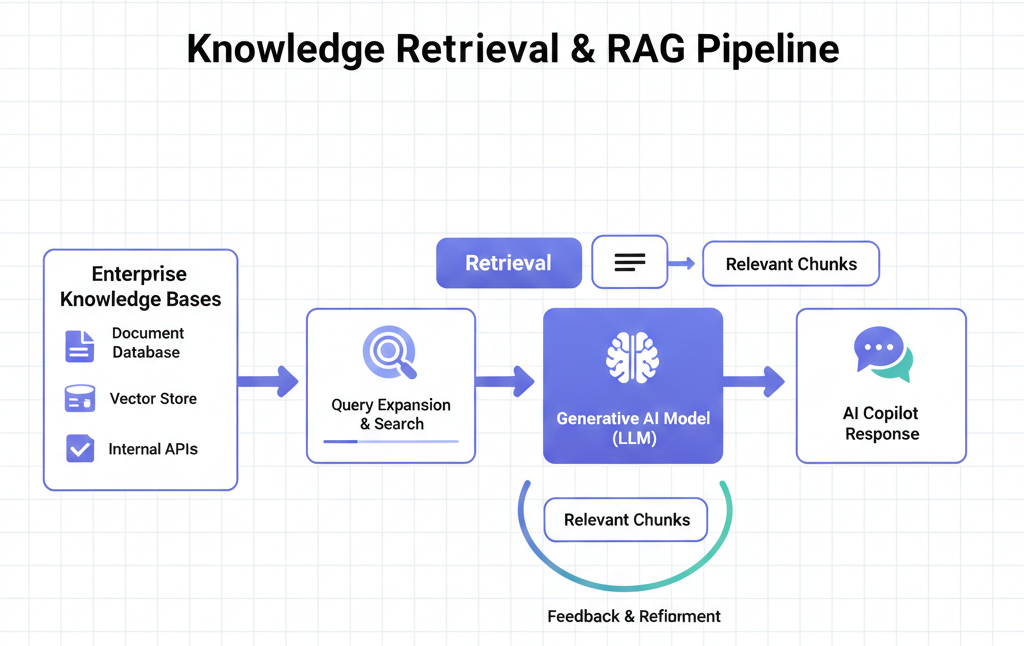
Retrieval-augmented generation (RAG) architectures enable copilots to retrieve relevant enterprise data before generating responses. Access controls should mirror existing document permissions, ensuring users only see information they are authorized to access. Continuous updates to knowledge sources prevent stale or misleading outputs.
Context quality directly determines copilot reliability.
5. Measure Value Beyond Usage Metrics
Enterprise leaders evaluate copilots based on business outcomes—not conversation counts.
Meaningful performance indicators include time saved per employee, reduction in support tickets, faster decision cycles, improved task completion rates, and measurable improvements in customer satisfaction. Trust and reliability are also key adoption indicators.
Copilots must demonstrate clear return on investment to justify long-term scaling.
6. Control Cost and Performance at Scale
As adoption grows, inference and infrastructure costs increase. Enterprises must proactively manage performance and cost efficiency.
Strategies include routing requests to cost-appropriate models, caching frequently asked queries, limiting token usage by role or workflow, batching non-urgent processing tasks, and monitoring cost per interaction. Cost governance should be built into platform design rather than added reactively.
Scalable copilots balance capability with financial sustainability.
7. Design for Human Oversight and Trust
Enterprise environments require accountability and oversight. Copilots should provide recommendations while leaving final decisions to human users, particularly for critical financial, legal, or operational actions.
Best practices include human-in-the-loop approvals for sensitive tasks, transparent confidence indicators, easy escalation to subject matter experts, and structured feedback loops for continuous improvement.
Trust is the foundation of long-term adoption. Without it, copilots become underutilized tools rather than strategic assets.
Conclusion
AI copilots are redefining enterprise productivity by embedding intelligence directly into everyday workflows. When built with secure architecture, strong governance, contextual knowledge integration, and measurable performance tracking, they become strategic platforms rather than experimental features.
Enterprises that approach copilots with a long-term, scalable vision—focused on business outcomes, cost control, and user trust—will unlock sustained competitive advantage in the era of intelligent automation.
Looking AI Copilots for Enterprises?
- Connect us – https://internetsoft.com/
- Call or Whatsapp us – +1 305-735-9875
In the end
Choosing the right enterprise AI copilot strategy in 2026 depends on your business goals, data readiness, system integrations, scalability requirements, and the complexity of enterprise workflows you want to augment. Whether you’re deploying AI copilots for customer support, operations, engineering, sales, or decision intelligence, today’s advances in large language models, automation, and generative AI enable powerful, context-aware assistants that drive measurable productivity gains. As AI continues to mature, enterprise copilots are becoming more secure, explainable, and production-ready—empowering organizations to work smarter, faster, and with greater confidence.
As a leading software development company in California, Internet Soft helps enterprises design, build, and scale AI copilots that integrate seamlessly with existing systems and processes. From defining copilot use cases and data foundations to model selection, deployment, and continuous optimization, Internet Soft delivers end-to-end AI copilot solutions tailored for enterprise environments.
By partnering with Internet Soft, a trusted AI development partner, organizations can ensure their AI copilots are built using the latest AI technologies and enterprise best practices. Our focus on security, scalability, performance, and real-world adoption ensures that AI copilots deliver intelligent assistance, operational efficiency, and sustainable business impact across the enterprise.
ABOUT THE AUTHOR

Abhishek Bhosale
COO, Internet Soft
Abhishek is a dynamic Chief Operations Officer with a proven track record of optimizing business processes and driving operational excellence. With a passion for strategic planning and a keen eye for efficiency, Abhishek has successfully led teams to deliver exceptional results in AI, ML, core Banking and Blockchain projects. His expertise lies in streamlining operations and fostering innovation for sustainable growth