

AI is reshaping the SaaS landscape, powering everything from intelligent automation to predictive analytics and AI copilots. But building an AI SaaS product is very different from simply adding smart features to existing software.
AI brings new challenges in infrastructure, data, cost, and continuous improvement. To succeed, teams must design AI SaaS products that are scalable, reliable, secure, and cost-efficient from day one.
This guide outlines the key steps to plan, build, and scale high-performing AI SaaS products.
What Makes AI SaaS Different from Traditional SaaS?
Traditional SaaS applications are deterministic—the same input consistently produces the same output. AI SaaS products, on the other hand, are probabilistic and continuously evolving.
AI systems depend on training data, inference compute, feedback loops, and ongoing retraining. Performance may vary based on changing user behavior and data distributions. This means AI SaaS requires continuous monitoring, optimization, and improvement rather than one-time feature delivery.
In short, AI SaaS is a living system, not static software.
1. Define a Narrow, High-Value Use Case First
The most successful AI SaaS products begin with a tightly scoped, high-impact use case. Instead of building a generic AI platform, focus on solving a specific, repetitive problem for a clearly defined user persona.
Examples include automated invoice processing for small businesses, AI-powered sales email generation for B2B teams, or predictive maintenance for industrial equipment. A narrow scope accelerates product-market fit, reduces development complexity, and enables faster validation of measurable ROI.
Clarity at the start prevents costly overengineering later.
2. Design a Scalable, Multi-Tenant AI Architecture
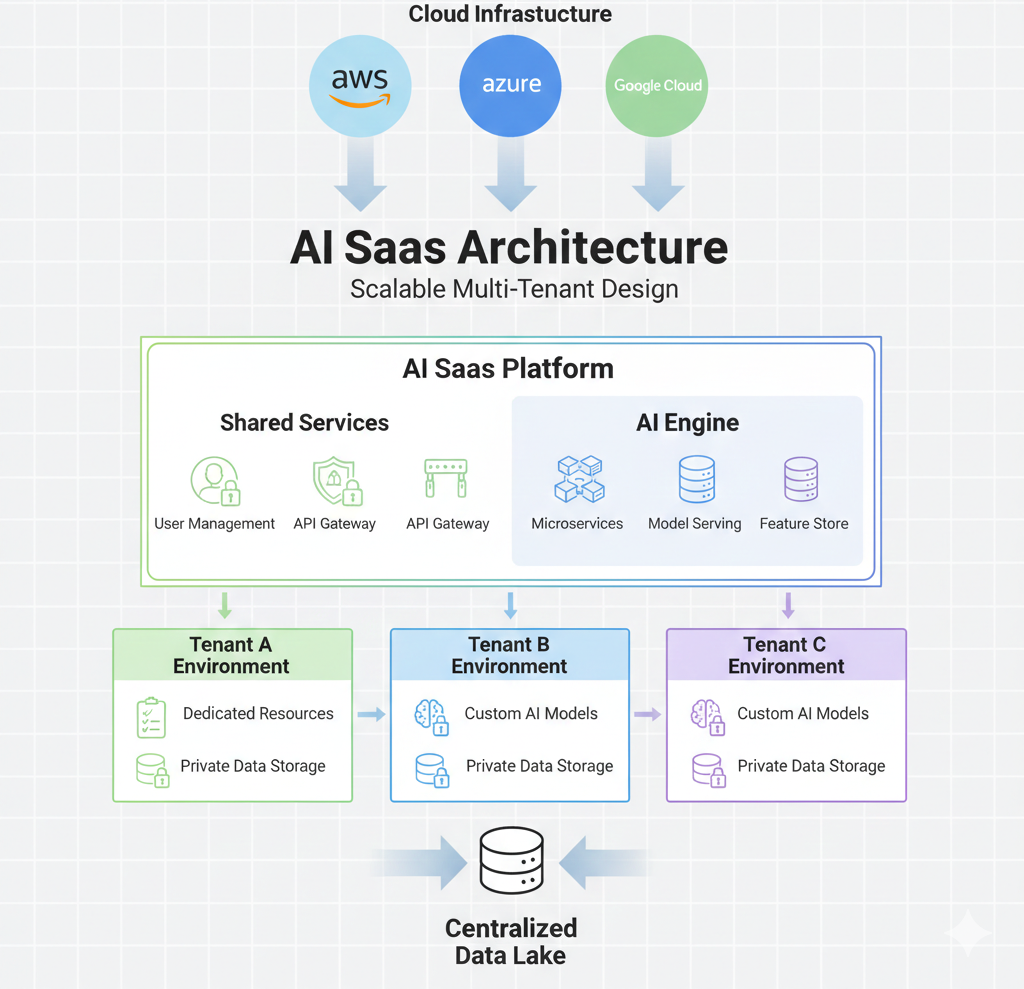
AI SaaS must support multiple customers while maintaining strict data isolation and cost efficiency. Multi-tenancy is essential, but it must be implemented with strong security and governance controls.
Core architectural principles include shared base models with optional tenant-specific fine-tuning, autoscaling inference services, asynchronous processing for heavy AI tasks, and API-first design for seamless integrations. Proper architecture ensures you can scale users and workloads without replatforming or excessive infrastructure costs.
Scalability should be engineered upfront—not retrofitted later.
Explore our approach to scalable AI/ML solutions →
Internet Soft AI/ML Services
A well-designed architecture lets you grow users and workloads without replatforming.
3. Build a Robust Data Pipeline from Day One
Data is the fuel of AI SaaS. Without reliable pipelines, even the best models fail in production.
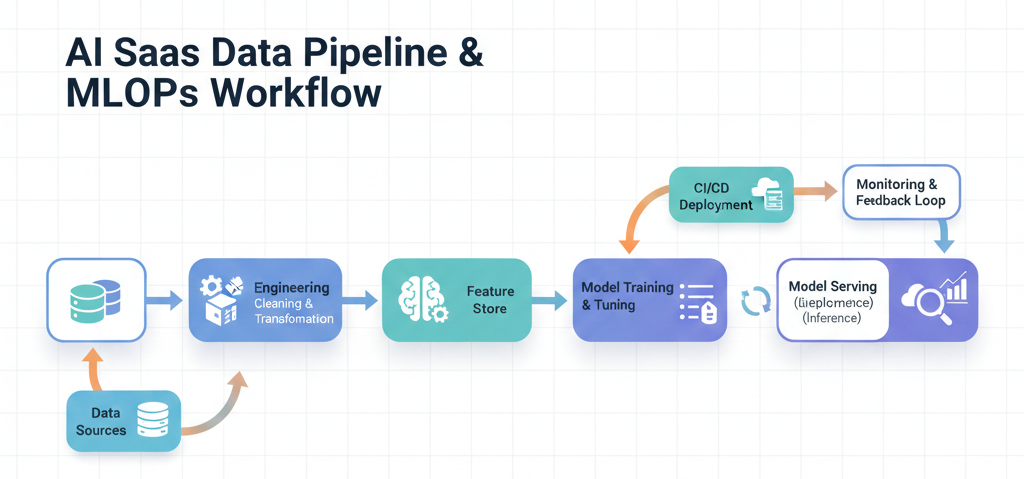
Your product should include secure data ingestion mechanisms, automated cleaning and validation processes, feature engineering workflows, tenant-level data segregation, and structured feedback capture for continuous learning. Poor data hygiene leads to model drift, inconsistent outputs, and loss of user trust.
A well-designed data pipeline transforms customer interactions into continuous product improvement.
4. Implement Production-Grade MLOps
Shipping the first model is only the beginning. AI SaaS products require disciplined MLOps practices to remain reliable and competitive.
Production-grade MLOps includes automated training and deployment pipelines, model versioning and rollback capabilities, A/B testing of model variants, monitoring for accuracy and latency, drift detection, and scheduled or trigger-based retraining. These practices ensure your AI system evolves without disrupting users.
Operational excellence is what separates experimental AI from scalable AI SaaS.
5. Control Cost and Performance at Scale
AI inference can quickly become the largest operating expense in your SaaS business. Cost control must be embedded into your technical and business strategy.
Optimization approaches include using smaller or distilled models where feasible, caching common predictions, batching heavy requests, implementing rate limits per tenant, and tracking cost per prediction or per customer. Real-time cost visibility helps align engineering decisions with financial sustainability.
Profitability in AI SaaS depends as much on efficiency as on innovation.
- Prioritize Security, Privacy, and Compliance
AI SaaS products often process sensitive customer data, making security and compliance non-negotiable.
Best practices include strong tenant isolation, encryption at rest and in transit, detailed audit logging, configurable data retention policies, and adherence to standards such as SOC 2, GDPR, or HIPAA when applicable. Customers must have clear visibility and control over how their data is handled.
Trust becomes a major competitive advantage in AI-driven markets.
7. Design for Human-in-the-Loop Workflows
Fully automated AI systems rarely meet enterprise-grade reliability expectations. Human-in-the-loop workflows improve both performance and trust.
Users should be able to review and correct AI outputs, override automated decisions when necessary, and provide feedback that feeds back into model improvement. These interactions generate labeled data, increase transparency, and strengthen user confidence.
AI SaaS should empower users—not replace their judgment.
8. Choose the Right Monetization Model
AI SaaS pricing must balance customer value with infrastructure costs. Unlike traditional SaaS, compute usage directly impacts margins.
Common monetization approaches include per-user pricing combined with AI usage credits, per-prediction or per-request billing, tiered plans with AI limits, and outcome-based pricing for high-value use cases. Align pricing with measurable ROI while ensuring compute costs remain sustainable.
Strategic pricing is as critical as technical architecture.
Conclusion
Building AI SaaS products requires far more than strong models. It demands scalable multi-tenant architecture, robust data pipelines, disciplined MLOps, cost optimization, and rigorous security controls.
Start with a focused, high-value use case. Design for scale from day one. Embed monitoring, feedback, and retraining into your operating model. Teams that treat AI as an evolving service rather than a static feature will build SaaS products that scale reliably, delight customers, and remain profitable in the long term.
Looking to launch or scale an AI-powered SaaS product?
- Connect us – https://internetsoft.com/
- Call or Whatsapp us – +1 305-735-9875
In the end
Choosing the right AI/ML solutions in 2026 depends on your business objectives, data maturity, scalability needs, and the complexity of problems you aim to solve. Whether your focus is predictive analytics, intelligent automation, computer vision, natural language processing, or generative AI, the AI/ML approaches and technologies available today offer flexible, powerful ways to drive innovation and measurable business outcomes. As AI continues to evolve rapidly, these solutions are becoming more adaptive, explainable, and production-ready—enabling organizations to build smarter, faster, and more resilient systems.
As a leading software development company in California, Internet Soft is committed to delivering high-impact AI and machine learning solutions that help businesses stay competitive in an AI-first world. From startups exploring AI adoption to enterprises scaling advanced ML models, Internet Soft provides end-to-end AI services—from strategy and data engineering to model development, deployment, and optimization.
By leveraging the expertise of Internet Soft, a trusted AI/ML development partner, you can be confident that your solutions are built using the latest AI technologies and best practices. Our focus on performance, scalability, and real-world usability ensures that your AI initiatives deliver intelligent experiences, operational efficiency, and sustainable business growth.
ABOUT THE AUTHOR

Abhishek Bhosale
COO, Internet Soft
Abhishek is a dynamic Chief Operations Officer with a proven track record of optimizing business processes and driving operational excellence. With a passion for strategic planning and a keen eye for efficiency, Abhishek has successfully led teams to deliver exceptional results in AI, ML, core Banking and Blockchain projects. His expertise lies in streamlining operations and fostering innovation for sustainable growth