

Artificial Intelligence is rapidly evolving from passive systems that respond to prompts into active systems that can plan, decide, and take actions independently. This shift is driven by the rise of Agentic AI—AI systems designed to operate autonomously, pursue goals, and interact dynamically with their environment.
Unlike traditional AI models that require constant human input, agentic systems can break down complex tasks, make decisions, and execute multi-step workflows with minimal supervision. This makes them highly valuable for enterprise automation, decision intelligence, and complex problem-solving.
In this blog, we explore what Agentic AI is, how it works, key components, enterprise use cases, and best practices for implementation.
What is Agentic AI?
Agentic AI refers to AI systems that act as autonomous agents capable of understanding goals, planning actions, executing tasks, and adapting based on feedback. These systems go beyond simple prediction or generation—they operate with intent and continuity.
Instead of responding to a single query, an agent can handle an entire workflow. For example, rather than just answering a question, an agent could research information, analyze options, generate a report, and even trigger actions in connected systems.
This makes Agentic AI particularly powerful for enterprise environments where tasks are multi-step, dynamic, and decision-heavy.
How Agentic AI Works?
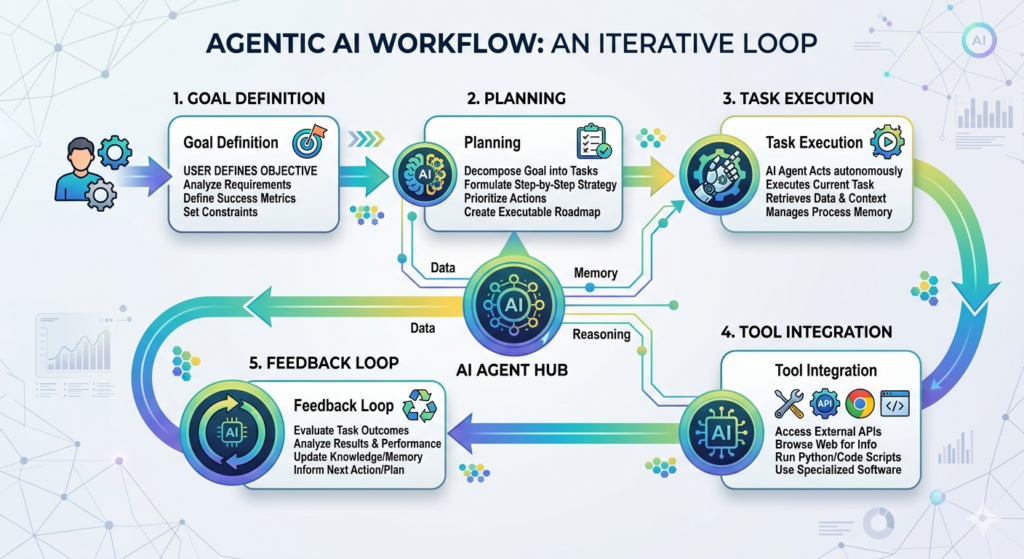
Agentic AI systems are built by combining large language models with planning, memory, and tool integration capabilities. These components enable the system to function like a digital operator rather than a static model. A typical agent workflow begins with a defined goal. The agent then breaks this goal into smaller tasks, determines the sequence of actions, and executes them step by step. During execution, it can access external tools such as APIs, databases, or enterprise systems.
As the agent progresses, it evaluates outcomes, adjusts its approach if needed, and continues until the objective is achieved. This iterative loop of planning, acting, and learning is what differentiates agentic systems from traditional AI.
Core Components of Agentic AI Systems
Agentic AI relies on several foundational components working together to enable autonomy and adaptability.
A reasoning engine allows the agent to interpret goals and decide what actions to take. This is typically powered by advanced language models capable of multi-step reasoning.
Memory plays a critical role by storing past interactions, intermediate results, and contextual information. This allows the agent to maintain continuity across tasks and improve over time.
Planning modules help the agent break down complex objectives into manageable steps and define execution strategies. These modules ensure that the agent operates in a structured and goal-oriented manner.
Tool integration enables agents to interact with external systems such as CRMs, databases, APIs, or automation platforms. This allows them to move beyond generating responses and actually perform actions.
Finally, feedback loops allow agents to evaluate outcomes and refine their approach dynamically, improving accuracy and efficiency over time.
Agentic AI vs Traditional AI Systems
Traditional AI systems are reactive. They respond to inputs and generate outputs based on learned patterns but do not take initiative or manage workflows independently.
Agentic AI systems, on the other hand, are proactive. They can initiate actions, manage multi-step processes, and adapt to changing conditions without requiring constant human intervention.
This shift transforms AI from a tool into a collaborator. Instead of assisting with isolated tasks, agentic systems can handle end-to-end processes, making them significantly more impactful for enterprise use cases.
Enterprise Use Cases of Agentic AI
Agentic AI is unlocking new levels of automation and intelligence across industries.
- In customer support, agents can handle complete resolution workflows—from understanding user queries to retrieving information, generating responses, and updating backend systems. This reduces resolution time and improves customer experience.
- In IT and DevOps, agentic systems can monitor infrastructure, detect anomalies, troubleshoot issues, and even execute remediation steps automatically, reducing downtime and operational overhead.
- In sales and marketing, agents can research prospects, generate personalized outreach, schedule follow-ups, and update CRM systems, enabling more efficient and scalable engagement.
- In finance and operations, agentic AI can automate processes such as invoice handling, reconciliation, reporting, and compliance checks, improving accuracy and reducing manual effort.
Across these scenarios, the key value lies in end-to-end task execution rather than isolated assistance.
Benefits of Agentic AI for Enterprises
- Agentic AI enables organizations to move from task automation to workflow automation. This significantly improves operational efficiency by reducing manual intervention across complex processes.
- It also enhances decision-making by combining data analysis, reasoning, and execution within a single system. This leads to faster and more consistent outcomes.
- Another major benefit is scalability. Agentic systems can handle large volumes of tasks simultaneously, making them ideal for enterprise-scale operations.
- Additionally, by automating repetitive and time-consuming workflows, organizations can allow human teams to focus on higher-value strategic activities.
Challenges and Risks
Despite its potential, Agentic AI introduces new challenges that organizations must address.
- One major concern is control and reliability. Autonomous systems must be carefully designed to ensure they operate within defined boundaries and do not take unintended actions.
- Security is another critical factor, especially when agents have access to sensitive enterprise systems and data. Strong authentication, access control, and monitoring mechanisms are essential.
- There is also the risk of error propagation. Since agents operate across multiple steps, a mistake early in the process can impact the final outcome if not detected.
Finally, governance and compliance become more complex, as organizations must ensure transparency, auditability, and accountability in agent decisions and actions.
Best Practices for Implementing Agentic AI
Organizations should start with clearly defined use cases where multi-step automation delivers measurable value. Beginning with controlled environments helps reduce risk while demonstrating impact.
Human-in-the-loop mechanisms should be implemented for critical workflows to ensure oversight and intervention when needed. This builds trust and prevents unintended consequences. It is also important to design strong guardrails, including role-based permissions, action limits, and validation checks before executing critical operations. Monitoring and observability should be built into the system to track agent behavior, performance, and outcomes. Continuous feedback loops help improve reliability over time.
Finally, organizations should invest in robust architecture that supports scalability, security, and integration with existing enterprise systems.
The Future of Agentic AI
Agentic AI represents a significant step toward more autonomous and intelligent systems. As models improve and integration capabilities expand, agents will become more capable of handling increasingly complex tasks.
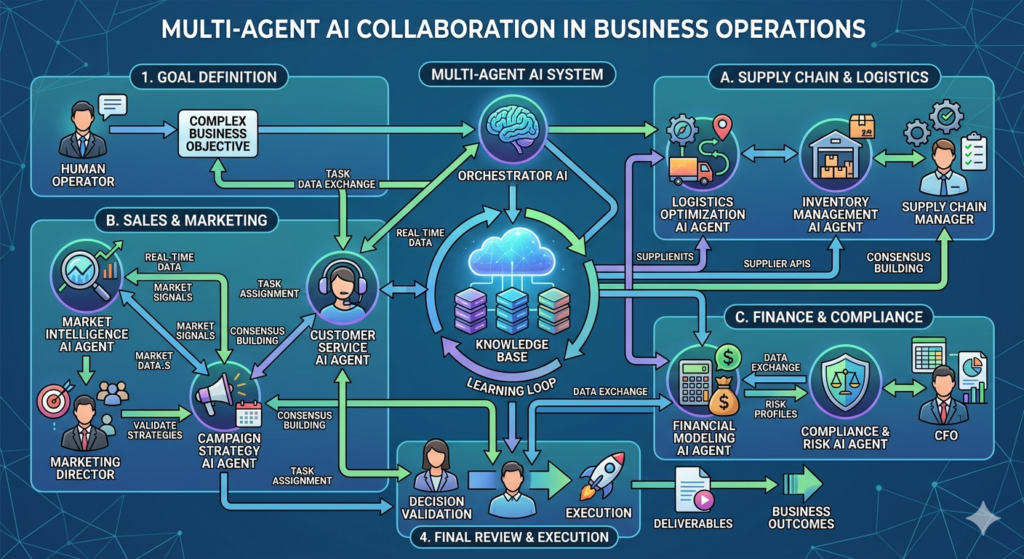
Future developments will likely include multi-agent systems where multiple AI agents collaborate to achieve shared goals. These systems will enable even more sophisticated workflows and decision-making capabilities. We can also expect deeper integration with enterprise platforms, enabling seamless automation across entire business ecosystems.
As the technology matures, Agentic AI will become a core component of enterprise AI strategies, driving productivity, efficiency, and innovation.
Conclusion
Agentic AI is transforming artificial intelligence from a reactive tool into an autonomous system capable of planning, decision-making, and execution. By enabling end-to-end workflow automation, it offers significant opportunities for enterprises to improve efficiency, reduce costs, and scale operations.
However, successful adoption requires careful planning, strong governance, and robust system design. Organizations that approach Agentic AI strategically—balancing autonomy with control—will be best positioned to unlock its full potential and build the next generation of intelligent business systems.
Explore our AI/ML services below
- Connect us – https://internetsoft.com/
- Call or Whatsapp us – +1 305-735-9875
ABOUT THE AUTHOR

Abhishek Bhosale
COO, Internet Soft
Abhishek is a dynamic Chief Operations Officer with a proven track record of optimizing business processes and driving operational excellence. With a passion for strategic planning and a keen eye for efficiency, Abhishek has successfully led teams to deliver exceptional results in AI, ML, core Banking and Blockchain projects. His expertise lies in streamlining operations and fostering innovation for sustainable growth